
Europe External Programme with Africa is a Belgium-based Centre of Expertise with in-depth knowledge, publications, and networks, specialised in issues of peacebuilding, refugee protection, and resilience in the Horn of Africa. EEPA has published extensively on issues related to the movement and/or human trafficking of refugees in the Horn of Africa and on the Central Mediterranean Route. It cooperates with a wide network of universities, research organisations, civil society, and experts from Ethiopia, Eritrea, Kenya, Djibouti, Somalia, Sudan, South Sudan, Uganda, and across Africa. The Situation Reports can be found here. To receive the situation report in your e-mail, click here. You can unsubscribe at any moment through the link at the bottom of each e-mail.
Walid hearing verdict (per 27 January 2026)
- The judges in the Dutch court in Zwolle found the suspect in the ‘Walid’ case guilty of almost all charges and sentenced him to the maximum of 20 years in prison.
- The full verdict comprises around 100 pages. The judge presented the main points of the verdict during the hearing today.
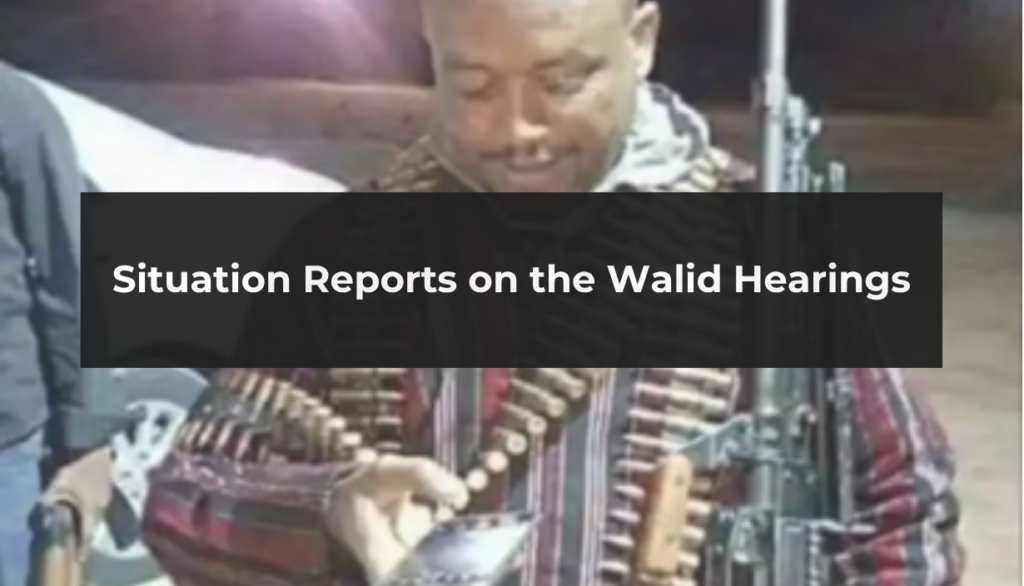
- The suspect know as ‘Walid’ or ‘Tewelde Goitom’ was accused of leading a criminal network that detained, tortured, raped and extorted refugees in Libya as part of a criminal organisation. It is one of the biggest cases of its kind ever tried in The Netherlands. The trial dossier has 25.000 pages.
- Kidane Zekarias Habtemariam, accused of similar crimes, was extradited from the United Arab Emirates to The Netherlands on 24 December 2025. His case will start on the 31st of March 2026.
The verdict (per 27 January 2026)
- The court noted the large difference of opinion between the public prosecutor and the defense when it came to whether the Dutch court has jurisdiction to rule in this case.
- The court ruled that it has jurisdiction based on the principle of territoriality when it comes to the majority of the charges, affirming that part of the crimes occurred in the Netherlands.
- The court found that it does not only matter where crimes are committed, but also where their effects are experienced, as part of determining the locus delicti (place of the crime).
- The court ruled that the extortion facts were partly committed in The Netherlands, as the threatening phone calls to extort the Eritrean refugees were received by family members in The Netherlands.
- On the smuggling crime allegations, the court ruled that the smuggling is completed at the point that the refugees reach their end destination, which for the vast majority of the witnesses heard in the case, is The Netherlands.
- The court noted that there was a causal link between the smuggling act by Walid and the arrival of the refugees in The Netherlands. “Without the criminal acts of the suspect, if proven, the migrants would have not reached The Netherlands.”
- Therefore, the court ruled that it has jurisdiction on the basis of Article 2 of the Dutch criminal code.
- The court ruled it does not have jurisdiction in the cases of 2 refugees that testified, one of whom never arrived in The Netherlands and the other who was relocated from Niger to The Netherlands.
- The court ruled that the crimes that it has jurisdiction over can also be proven. The judge stated that the testimonies of the refugees were very similar, including in specific details. The testimonies are supported by the poor state in which the refugees arrived in Italy; underfed, injured and ill.
- The testimonies are also supported by satellite images and pictures.
- The court ruled that it also considered it proven that the suspect in court was in fact the same person, known as ‘Walid’, who committed the crimes against the refugees in Bani Walid, Libya.
- The court came to this conclusion on the basis of recognition by the witnesses of Walid on the pictures, but also on the basis of the Facebook accounts, one of which was active near Bani Walid, and the false identity papers he carried at his arrest and which he tried to obtain while in The Netherlands.
- The court did not find that there was enough evidence to conclude that there was a consistent cooperation between the different smugglers, including Kidane, active in Bani Walid.
- Therefore, Walid was acquitted of some of the crimes which were committed against refugees who were smuggled by Kidane, which were added to the case on the basis of the assumed cooperation.
- The court did find that Walid had cooperated with accomplices that worked in Bani Walid under Walid’s command, so-called ‘kapos’ which did his bidding.
- The court therefore considers it proven that Walid participated with others in a criminal organisation focused on extortion and human smuggling, and also considers proven his complicity in human smuggling which endangered lives, and complicity in extortion.
- The court ruled that Walid can be held fully accountable for his crimes. At no stage did he express any remorse for his actions.
- Due to the extensive nature and the severity of the crimes, the court ruled that Walid receives the maximum sentence of 20 years.
- The judge emphasised that Walid’s actions have undermined the EU and Dutch migration laws, but also exposed migrants to extraordinarily cruel and inhumane circumstances. The judge stated Walid acted “without compassion, ruthless and without any regard for human dignity, to extort as much money as possible from defenseless people.”
- The jail time that followed from the Ethiopian case will not be taken into account as asked by Walid’s defense, as there is no decision yet about whether the transfer of the sentence will be accepted.
- The claim by the lawyers of the victims has been awarded by the court, except for the two victims that fell outside of the court’s jurisdiction.
Additional details (per 27 January 2026)
- Walid had urgent matters to discuss with lawyers before the proceedings, which delayed the hearing.
- The court encountered some technical difficulties so the livestream was not working for the first part of the proceedings.
- Prior to the verdict, the judge noted new developments, including Kidane’s questioning and additional evidence from the GBA (Municipal Personal Records Database). The prosecution and Walid’s defence both indicated that the new developments did not change their standpoints.
- Kidane was heard as a witness in Walid’s case on 26 January 2026 (yesterday). However, he chose to answer no questions except for whether he had been in touch with the Eritrean journalist Samuel Hail, which he denied.
- A video by Samuel Hail was presented as evidence by the public prosecutor of cooperation between Walid and Kidane.
- Walid will have the chance to appeal the ruling, which he has to apply for within two weeks. It is expected he will do so.
Responses (per 27 January 2026)
- Representatives of the Eritrean community present were thankful for the ruling. “We have followed his case for so many years, and now we finally have the outcome. At least he got the maximum sentence possible.”
Links of interest
Full verdict (in Dutch)
20 jaar cel voor grootschalige en gewelddadige mensensmokkel van Eritrese migranten
Dutch court sentences Eritrean man to 20 years for cruel people smuggling
20 jaar cel voor Eritreeër voor leiden gewelddadige mensensmokkelbende
Eritrean Trafficker Jailed in Landmark Dutch Case
Human trafficker who tortured migrants in Libya jailed for 20 years in Netherlands
Hij genoot van martelen, verkrachten en vermoorden van kwetsbaren, en verdiende er nog geld aan ook
Human trafficker who tortured migrants in Libya jailed for 20 years in Netherlands
20 jaar gevangenisstraf voor Eritrese mensensmokkelaar ‘Walid’
Disclaimer: All information in this Situation Report is presented as a fluid update report, as to the best knowledge and understanding of the authors at the moment of publication. EEPA does not claim that the information is correct but verifies to the best of ability within the circumstances. Publication is weighed on the basis of interest to understand potential impacts of events (or perceptions of these) on the situation. Check all information against updates and other media. EEPA does not take responsibility for the use of the information or impact thereof. All information reported originates from third parties and the content of all reported and linked information remains the sole responsibility of these third parties. Report to info@eepa.be any additional information and corrections.